Blog | Student Housing
PBSA Budgets: Why We’re No Longer Comparing ‘Apples with Apples’ Vicky Bingham

Student accommodation has matured rapidly as an asset class. Institutional capital, with sophisticated operating partners, encompassing highly detailed financial modelling have all contributed to increased reliability of the sector. However, as a by-product of accelerating maturity, landlords and their operating partners are value engineering budgets to reflect operational nuances.
Given the sector derives its asset values by Net Operating Income (NOI), understanding budgets has never been so important for agents and valuers.
What we see in practice is great variances in the way operational costs are defined, allocated and forecast between operators. As a result, when we compare the NOI position of an asset, we frequently are not comparing like with like.
Three Developments Reshaping the Market
On the surface, operational expenditure (opex) in student accommodation seems relatively straightforward: staffing, utilities, repairs, marketing, management. But the composition of opex depends heavily on how an operator chooses to run the building.
Recently, we received three operating budgets for the same building from three different well established student accommodation operators. Each assumed broadly similar rental incomes, yet the headline NOI position materially differed. Clearly the reason wasn’t revenue driven - it was embedded in what each operator considered to be “operational cost” and the assumed costs attributed to each item.
Some examples included:
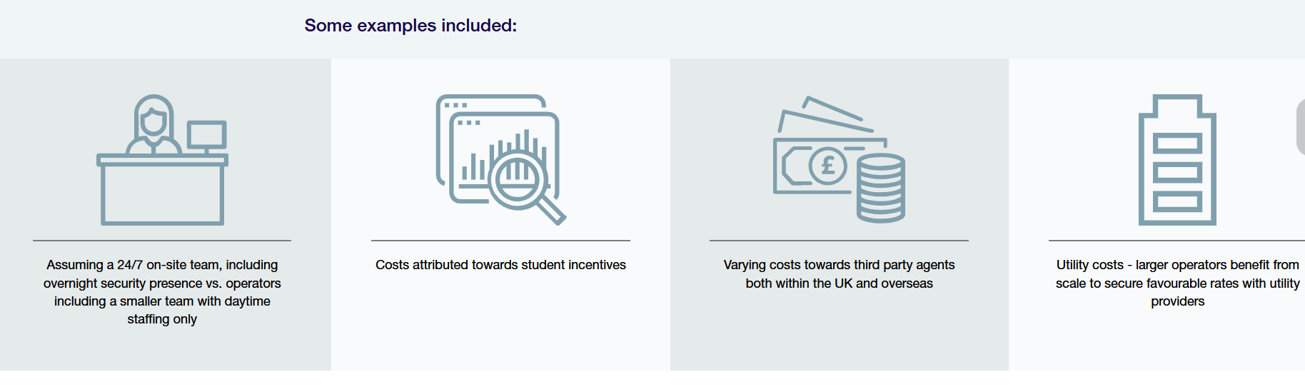
Each approach often looks defensible and not without justification, but each creates a very different cost base with the resulting position driving value and making it difficult to draw comparisons between buildings.
The Blurred Line Between Opex and Capex
The situation becomes more complex when we look at where operators draw the line between operational expenditure and capital expenditure.
Furniture replacement provides a common example. One operator might expense regular furniture and mattress replacement through the P&L to maintain a consistently high-quality offer. Another may capitalise replacements on a longer refurbishment cycle under long term capex. The building looks the same to a resident—but the financial performance appears very different on paper.
Similar discrepancies occur with:
- Technology upgrades (WiFi infrastructure, access control)
- Preventative maintenance vs. reactive repairs
- ESG-led improvements, such as energy efficiency enhancements
In one recent budget comparison, an operator included significantly higher annual maintenance costs, justified as preventative spend to protect long-term asset performance. Another showed lower annual opex but assumed a periodic capital injection every few years. Again, neither approach is “wrong”, but they are not directly comparable.
Service Levels: The Hidden Variable in Yield Comparisons
Student accommodation is no longer a uniform product with service levels varying widely. Certain schemes offer a hospitality led model competing with the BTR products now available, featuring concierge style services, enhanced communal areas and regular events with intensive student support. On the other end of the spectrum, others provide a functional, affordable and minimalistic approach. Ultimately the higher end service levels result in a higher operating cost centre and therefore a simple NOI and subsequent net yield snapshot rarely captures these dynamics.
“Apples with Apples”
From our experience of reviewing operational costs from various landlords and third-party operators it is fair to say that there is an element of independent judgement of what is deemed ‘above the line’ and ‘below the line’ cost. As a sector, we do not have a consistent definition of what sits in opex and what sits in capex. Nor what level of service is assumed and what ‘stabilised’ really means. For this reason, we are never comparing ‘apples with apples’ when comparing the net position of a PBSA asset.
Is there an argument that PBSA should be marketed on gross yield basis?
This raises a legitimate question: should the sector place greater emphasis on gross yields, at least at the point of marketing and for comparative purposes?
For example, traditionally, HMO investments have nearly always been marketed on gross yields exclusive of utility costs only. Investors then apply their own management, service and cost assumptions to assess net performance. That approach acknowledges an important truth that operating costs are variable and often contingent on how an investor chooses to run the asset. By marketing assets on a gross yield basis, we accept that:
- The focus is on the headline gross income, which is factual reflecting signed contracts
- It allows investors to model multiple operating scenarios
- Avoids embedding subjective cost assumptions into a headline return number
Net analysis is necessary
This is not an argument for abandoning net yields for gross yields or moving away from net value-based analysis altogether. Net performance remains fundamental once an operator and service model are clearly defined. It is why and how PBSA can speak to and attract institutional investment. And poor practice operators should not be able to hide inefficiency behind attractive gross numbers.
However, adopting an assets net yield position as a universally comparable metric - without transparency around the assumptions behind it - is where problems arise.
A more transparent approach might involve:
- Marketing assets on gross yield
- Providing a clear yield bridge from gross income to net return
- Explicitly disclosing:
- Service levels
- Staffing models
- Capex vs. opex treatment
- Stabilisation assumptions
This allows investors to understand not just what the return is, but why it looks the way it does.
As an agent, there is a responsibility to scrutinise costs that are shared from landlords to ensure we are in the best position to accurately appraise an asset but also market the property at a level that will generate interest. It is important that we understand the mechanics behind the operation and can explain the rationale and justification of the budget a landlord has adopted.
It is right that landlords work with their operating partners to determine the most appropriate budget for their accommodation because no building is the same and the sector needs a varying degree of operating models to allow for affordability. But it has never been so important to understand operational costs, raise questions where costs move too far away from the ‘norm’ and be in a position of justification whether it be for agency appraisal or red book valuation purposes.
Related Insights

Podcast: The Student Housing Market: Opportunity, Affordability and the Road Ahead
Want to know more or would simply like some advice? We hope you find this podcast useful. If you want to know more about topi...

Owning an HMO Property: Weighing the Pros and Cons
Houses in Multiple Occupation (HMOs) have become a popular investment strategy for landlords seeking higher yields and divers...

The evolution of the student sector and changing levels of HMO supply
The future of the HMO market and the implications of the Renters’ Rights Act for PBSA Market Trends Investor focus remains co...

UK PBSA: Lower Transactional Volumes, But Why?
The UK Purpose Built Student Accommodation (PBSA) sector has seen a notable drop in transactional volumes over the past 18-24...