Blog
Upwards and Downwards Rent Reviews - Does It Matter?

Upward and Downward Rent Reviews – does it matter?
An upwards-only rent review (UORR) is a lease clause ensuring a rent review stays the same or increases, even if market rates fall. An upwards/downwards review clause (UDRR) enables the rent to rise or fall to reflect property market conditions.
The property industry was outraged by the Government's plan to ban "the unfair practice of upwards-only rent reviews" on commercial leases. Their provisions seek to address concerns primarily expressed by retail tenants whilst giving little assurance to landlords - but without consultation with the BPF. The Bill has now been given Royal Assent but the ban will need secondary legislation to bring it into effect and there is still a consultation on caps and collars to be worked through: so expect a ban in 2027 or 2028.
What Is Actually Being Proposed?
Perhaps the first thing to point out is that the Government is NOT proposing that UORRs are replaced by UDRRs – that would be extremely radical – they are proposing to ban rent reviews with a fixed base figure. So a base of any unfixed figure, that nevertheless rises reliably, will be fine: CPI for example. Therein lies the problem for tenants and the salvation for landlords because the effect may well be the death of Open Market rent reviews, while rents continue to only go up, but in line with inflation instead. We will explore later whether that favours landlords or tenants.
A Reckless Move Without Due Consideration
Open Market UORRs are the basis of the relatively stable income offered by UK leases which appeals to income investors at home and overseas. To throw that away may have major implications. To throw it away without even giving those implications due consideration is reckless and Hansard records that very little time has been spent exploring the issues at Committee. The issues debated so far show a level of understanding by our lawmakers that we would be disappointed to see in a summer intern. There is a political and an emotional angle to this, which needs addressing in Parliament but we as professionals we keep our heads, look at the evidence and make informed decisions.
What Does the Rest of the World Tell Us?
France operates a three-year cycle where rents move up or down, capped at 10% annually since 2014. Germany's indexation works upward and downward. The Netherlands and Singapore have similar mechanisms. The USA uses CPI-linked escalations and links to market rent.
So, the UK has been relatively unusual in its use of upward-only mechanisms in commercial markets.
Australia banned upward-only retail lease reviews over 20 years ago, still allowing them for office and industrial, and Ireland outlawed UORRs in 2010. Neither has seen pension fund collapse or market mayhem.
The Irish and Australian Experience
So what happened in these cases?
There is great hindsight narrative above – but we fear Parliament is not looking in the rear-view mirror. In Ireland, the ban followed the Global Financial Crisis. In the declining property market, landlords could not demand Index Linked Reviews. When recovery came, they avoided them, fearing they might miss rapid growth. By Covid, Upward and Downward reviews were the norm.
John Banbury, Allsop Lease Advisory:
The Irish story does not match the market conditions in the UK today. Landlords will avoid upward and downward reviews. Australia banned UORR in 2003 – new lettings moved to index linked bases and OMRR fell out of fashion.
Accepting an index linked RR at the bottom of a cycle is one thing, but quite another at the top, locking in growth on already high rents.
The Numbers Don't Lie — But Timing Is Everything
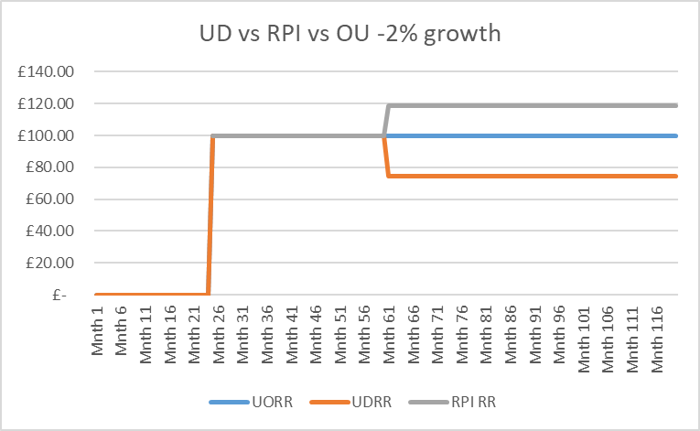
The graph below illustrates rent paid by 3 tenants during a 10 year lease where rents decline by -2% per year, depending on whether they have an index linked RR (grey), an UORR (blue) or an UDRR (red).
While the UDRR tenant is best off, the tenant who opted for index linked pays 20% more than their UORR competitor.
If the market grows by 2% per year, the UDRR tenant sees little benefit over UORR, but both are better off than the index linked tenant.
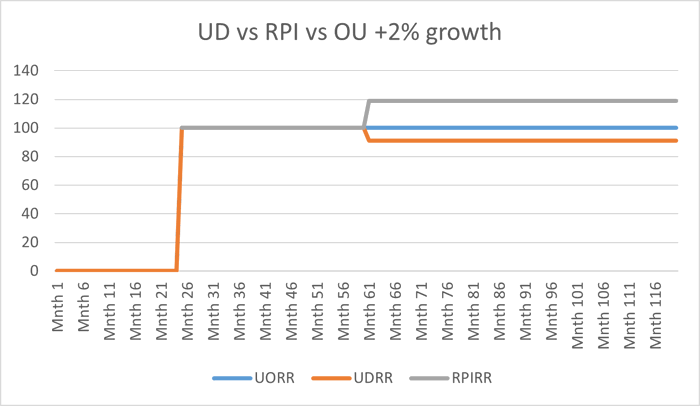
The moral of the story is: when choosing between RPI and UDRR, market timing is crucial.
Tenants do not want to be linked to RPI from the top of a cycle, but will small high street tenants (who this legislation seeks to protect) fully grasp the importance of this. If not, their landlord's will.
Posing the following questions:
- Most new leases are 5 years to first break without rent reviews. So will it really affect many tenants?
- Will UDRRs encourage longer or shorter leases?
- How will landlords react regarding investment decisions and income stability?
UORRs are criticised for dislocating rents from the market – true when rents fall, not when they rise. Index linked reviews dislocate rents regardless.
What Does This Mean for Valuations and Investment?
Taking the valuation perspective, income security is fundamental when advising banks. UDRR legislation may incentivise landlords to adopt shorter terms or a revert to index linked increases – already common in leisure leases and clearly more beneficial from a value perspective (except when capped in times of surging inflation). The former requires more thought.
Evie Robertson, Allsop Commercial Valuations
When advising banks, we prioritise income security, tenant covenant strength, and reversion/reletting prospects in the event of vacancy. With UDRRs, landlords must carefully balance protecting income against protecting value. Substantial over-renting can also alarm investors and adversely impact value, though this has subsided as 15 to 25 year leases have become a thing of the past.
Whilst landlords may view UDRRs negatively, its tenant appeal could improve letting prospects and encourage longer leases with the earlier rent rebasing of rents in challenging markets thereby reducing occupational risk.
Emily Rucker, West End Investment
Investors need stable returns to run a building. UORRs have been the cornerstone of predictability in the UK market, facilitating long term investment decision making.
Could the proposed UORR ban result in a two-tier market?
The ban will align the UK with international markets, but UDRRs may still concern international investors who historically sought the UK for income certainty.
So, Does It Actually Matter?
So back to the question – does it matter that Upward Only Rent Reviews are being banned? No. Because they are not being banned.
Does it matter that Open Market Reviews will become rare? That's a harder question. But landlords' lack of lobbying tells us who might benefit most.
Time will tell when UDRRs are implemented – likely only in weak markets – and whether tenants take longer leases or landlords keep them short.
Related Insights

Allsop raises over £70m at the UK’s largest commercial property auction in four years
Allsop, the leading property consultancy and the UK’s largest property auction house, has raised more than £70 million at its...

Central London Capital Markets Update - Q3 2026
Want to know more or would simply like some advice? Nick is co-head of the West End Business team, based in Wigmore Stre...

Allsop launches 10th residential auction catalogue of 2026 with 286 lots across two-day sale
The auction will be held over two days, with 16 lots guided at £1 million or more

Retail assets driving investor interest
The rise of e-commerce, later joined by the Covid-19 pandemic and the higher interest rate environment that followed it, led ...