Blog | The Property Market | Commercial Property | Investment | Valuation
Seven-Year Property Cycle? Not Any More

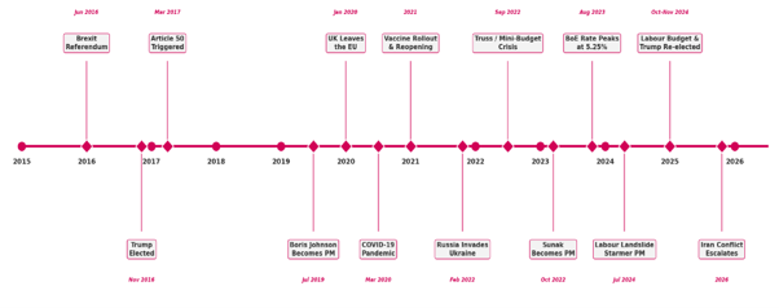
For decades, the UK commercial property market operated on a rhythm that investors, lenders and advisors could broadly set their watches by: a seven-year cycle of boom, correction and recovery, repeating with enough regularity that entire strategies were built around it. That model is now broken. The last decade has not been a cycle. It has been a sequence of shocks, each one arriving before the market had fully absorbed the last, and each one leaving a structural mark that a simple recovery cannot undo.
Three events above all others define this lost decade: Brexit, the COVID-19 pandemic, and the Truss mini-budget. Taken individually, each would have been significant. Taken together, they have fundamentally redrawn the UK property landscape.
The Shocks That Changed Everything
Brexit's dominant narrative was always about trade, labour and London's status as a financial centre, but its property consequences were more nuanced. Industrial and logistics emerged as clear winners, as businesses adapted supply chains and required more warehousing capacity to manage trade friction. Regional residential markets outside London held up well, supported by relative affordability. The losers were equally clear: prime London residential weakened as international investor demand retreated, development stalled under rising costs and EU labour shortages, and the office market faced sustained uncertainty around financial services occupiers.
Then came COVID-19, which delivered the most dramatic shift in occupier behaviour the UK market has ever seen in such a compressed timeframe. Logistics surged again as e-commerce accelerated. Suburban and rural housing markets boomed as buyers prioritised space over city-centre convenience. The residential rental sector proved resilient, underpinned by affordability pressures. But retail, particularly high street and shopping centres, was devastated by lockdowns and tenant failures. Offices suffered an immediate sharp drop in demand and a lasting behavioural shift with best in class amenity rich buildings becoming occupiers focus, and city-centre flats underperformed as dense urban living temporarily fell out of favour.
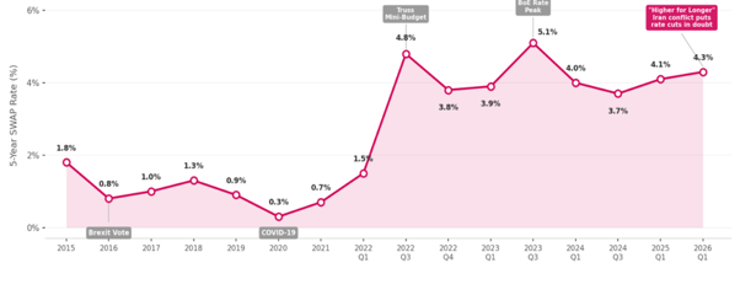
The third shock was the most acute in financial terms. The Truss mini-budget of September 2022 sent 5-year swap rates from around 1.5% at the start of that year to nearly 4.8% within weeks. To understand what that means for property, consider the trajectory: swap rates had sat at 1.8% in 2015, fallen to just 0.3% during the depths of COVID in 2020, and were only beginning to normalise when the mini-budget hit. The resulting repricing was brutal and immediate. Prime industrial values saw close to 200 basis points wiped off almost overnight. Offices moved 100 to 150 basis points. Even retail, which had already been heavily corrected by the structural shift to online shopping, was not immune. The episode was a stark reminder that property values are ultimately anchored to the cost of money, and when that cost moves violently, so do asset prices.
Swap rates have since settled in the 3.7% to 4.3% range, but the "higher for longer" environment has persisted. The Iran conflict has put further rate cuts in doubt, and the current reading of around 4.3% underlines that the era of cheap money underpinning the pre-2022 market is not returning quickly.
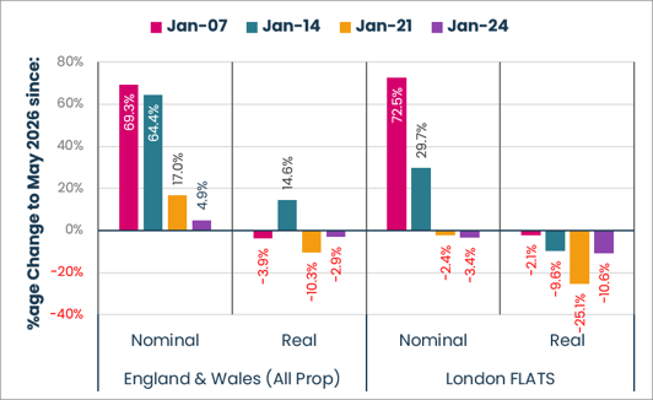
A Closer Look: Central London Offices and the London Flat Market
The Central London office market illustrates the cumulative weight of these shocks particularly well. In 2017, transaction volumes across the West End and City core reached £20.24 billion. Between 2021 and 2026, the average annual investment volume has been approximately £8.25 billion, a fall of around 60%. Interest rate stagnation, elevated build costs and an increasingly complex regulatory environment have all played a role. Planning has become slower, building safety compliance has added significant cost and delay, and banks have been broadly forgiving on LTV breaches where rent covers interest, which has reduced forced selling and constrained transaction liquidity.
Where Does This Leave Us?
After eleven years of disruption, the UK is now forecast to be the best-performing real estate market globally over the next five years, projected to deliver annualised returns of 7.1%, ahead of Europe, the United States and Asia Pacific. That forecast is not built on a sudden return of economic confidence. It is built on scarcity. Development activity has been subdued across all sectors for the better part of a decade, construction costs remain elevated, and meaningful new supply is not forthcoming. The UK also repriced earlier and more aggressively than its global peers following the rate shock, painful at the time but leaving the market comparatively well-positioned as capital begins to rotate back.
The sector performance data of the last decade makes the income story plain. Industrial and logistics have delivered double digit annualised total returns. Build-to-rent and living sectors are not far behind having returned circa 8.5%. Retail parks and student accommodation have each delivered around 7%. At the other end of the spectrum sit shopping centres, secondary offices and high street retail which all show negative real return growth.
The UK property market has shifted from being driven by location and capital growth to being driven by income. The beds and sheds thesis, once a contrarian view, is now simply the record. The cycle has not returned. What has emerged instead is a market shaped by structural supply constraints, persistent regulatory complexity and a cost of capital that remains materially higher than the decade before. For investors who understand that shift, the opportunity is real. For those still waiting for the old cycle to resume, the wait may be a long one.
This article was first published on 27th August 2026 in Green Street News. To view the article, click here.
Related Insights

The death of the rate-cut narrative is good news for real estate
Freddie Foley writes in Green Street News this week - property's edge over gilts rests on the one thing a bond can't do: grow...

Leasehold Reform: History in the Making
With approximately 4.8 million leasehold flats and houses across England, the Leasehold system is currently subject to a peri...

The Ugly Duckling: A Tale of Commercial Property Investment
Once upon a time, in the barnyard of investment opportunities, there lived what many considered an ugly duckling. Commercial ...

Alternative Investment - National Market Update Q2 2026
The National Investment team have released their Alternative market update for Q2 2026.