Client Money Handling Procedures
Allsop Letting and Management Limited (the firm) is regulated by The Royal Institution of Chartered Surveyors (RICS) and as such we are required to adhere to the provisions of RICS - Rules of Conduct for Firms.
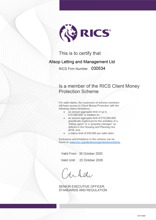
Client Money Protection Certificate
As the firm handles client money as ‘normal activity in the course of the business’ then Rule 8 of the Rules of Conduct for Firms states that ‘[a] firm shall preserve the security of clients’ money entrusted to its care in the course of its practice or business’. Its aim is to ensure that clients’ money can be clearly linked to the clients to whom it belongs and is protected on their behalf at all times.
Additionally, in relation to the specific activity of handling client money, as a member of the RICS Client Money Protection Scheme we are required to comply with RICS Client Money Protection Scheme: Rules which sets out that client money must be held in a client money account with a bank or building society authorised by the Prudential Regulatory Authority (PRA), the Bank of England and the Financial Conduct Authority (the FCA); and that a scheme member must:
- maintain one or more client money accounts into which all client money of the member is paid;
- ensure a client money account is designated as such and is easily distinguished from other accounts of the member;
- advise all clients of the member that client money will be held in a client money account and notify such clients of the details of that account;
- confirm in writing with the bank with which it holds a client money account that the bank acknowledges that monies in the client money account must not be combined with, or transferred to, any other account maintained by the member, and the bank shall not be entitled to exercise any right of set off or counterclaim against money in that client money account in respect of any sum owed to it in respect of any other account of the member firm;
- keep records and accounts which show all dealings with client money, and demonstrate that all client money held by the firm is held in a client money account.
As regards handling client money, a scheme member must:
- have and comply with written procedures for handling client money which must comply with any advice and guidance in relation to client money protection as issued by RICS from time to time;
- publish their procedures for handling client money on their website;
- provide a copy of their procedures for handling client money to any person who may reasonably require a copy, free of charge;
- keep records and accounts that show all dealings with client money;
- repay any client money, including where feasible any interest earned, without delay if there is no longer any requirement to retain that money or the relevant client requests it;
- hold and maintain professional indemnity insurance cover that is appropriate for the member’s size, income, type of work and the amount of client money held.
In order to ensure we have procedures in place to manage clients’ money effectively and to deliver an appropriate level of confidence to our regulatory bodies, our clients, both current and future, and stakeholders we follow the best practice advice as set out in RICS Clients’ money: General advice for firms.
Our best practice systems and controls are as designed on the following:
General Controls
- employees have clear segregation of duties and responsibilities and a Principal or appropriately qualified individual oversees the client accounting function;
- we employ competent and knowledgeable staff who are responsible for processing clients’ money and who are familiar with RICS Rules;
- our accounting systems and client data are securely controlled and protected;
- computer systems are adequately protected for access, firewalls, back-ups and disaster recovery;
- we ensure there is adequate cover for holiday and long-term absence;
- Principals cannot and do not override controls surrounding the accounting system;
- all of our departments and sites apply the same level of controls in relation to the client accounting function.
Client bank accounts
- we hold clients’ money in one or more client bank accounts separate from all other monies;
- client money is available on demand;
- the client bank account is correctly titled to include the name of the firm and the word “client” to distinguish the account from an office or any other account. If it is a discrete account, the name of the client is included in the account title;
- we obtain written confirmation from the bank of client account conditions;
- we advise clients in writing of the bank account details (account name and name and address of the bank) and agree the terms of the account handling, including arrangements for interest and charges;
- we have obtained written consent from the client if we retain any interest.
Client Accounting Systems and Controls
- our accounting records and systems are appropriate to the nature and volume of client account transactions;
- our systems provide details of all money received into and paid from all client accounts and show a running balance of all client money held in that account;
- our systems identify all receipts and payments to the client to which they relate; for example by means of client ledgers showing cash balances held on behalf of clients at all times;
- accounting records are completed chronologically and promptly;
- current balances at the total and client levels are always available;
- all ledgers have the client name and an appropriate description, e.g. the property address;
- overdrawn balances on client ledgers are prevented by the systems or controls in place and where they do occur are investigated and rectified immediately with any associated costs being suffered by the firm;
- we have adequate controls in place over unidentified client money to ensure that such funds are kept securely and that every attempt is made to locate a client and reimburse them at the earliest possible time. If funds are held for
more than three years then we donate these to a registered charity and obtain an appropriate indemnity should a claim subsequently arise; - we maintain a central list of client bank accounts including dates of opening and closing of accounts;
- a “three-way” reconciliation is completed at least once every month where clients’ money is held in a general client account. This is produced as a formal statement, and any unresolved differences or adjustments are fully investigated and explained. All errors identified in the reconciliation process are promptly rectified;
- client account reconciliations agree the cash book or system balances to bank statement balances and include a full list of:
- dated unpresented cheques;
- dated outstanding deposits;
- details of any other reconciling items;
- system reports supporting reconciliation figures, as appropriate;
- and for general client accounts, a list of client ledger balances and the total of the balances;
- reconciliations do not include regularly occurring adjustments or reconciling items more than three months old, except for unp esented cheques which should be no more than six months old;
reconciliations are reviewed and signed off by a Principal or an appropriate independent senior member of staff; - client accounting records, including copies of reconciliations, are securely kept for at least six years plus the current year.
Controls over the receipt of client money
- only a Principal or appropriate staff independent of accounting staff open incoming post;
- procedures exist to ensure all clients’ money is banked within three working days;
- all cash and cheques received by post or by hand are promptly recorded;
- a reconciliation is performed between money received by post and that day’s banking;
- procedures exist to identify and distinguish between clients’ and office money;
- mixed monies are initially paid into a client account and the office element paid to the office account when the receipt has cleared the bank;
- any fee received in advance for professional work not yet billed are paid into a client account pending completion of the work;
- cash receipts are actively discouraged and in the very rare instance where cash is received this is witnessed by at least two staff. Duplicate receipts are issued for cashreceived and controls over the physical security of cash are effective;
- unbanked client money receipts are kept secure.
Controls over the payment of client money
- checks are made to ensure that sufficient funds are held on behalf of the relevant client before payments are made;
a copy of the bank mandate is held and is up to date; - adequate authorisation and supervision procedures are in place for payments made by cheque, bank transfer and electronic methods;
- insurance and adequate Principal supervision is in place where payments are made by non-Principals;
- all payment requests have supporting evidence and that documentation has been authorised in advance by a Principal or other appropriate person;
- blank cheques are not signed, and unused cheques are kept securely;
- effective controls are in place over the setting up of new supplier accounts or amendment of existing supplier accounts on the system;
- cash payments are avoided.
Glossary
The bank account mandate is a contract between the bank and the firm setting out terms and conditions of the use of banking services. It states the respective rights and obligations of the bank and the firm and includes the names of individuals authorised to sign cheques, approve electronic payments and perform other banking activities in the name of the firm.
Blank cheques
A blank cheque is a cheque signed by an authorised signatory but which has not been completed with the name of the payee or the amount to be paid.
Cash book
A cash book is a record of all clients’ receipts and payments in chronological order which provides a running balance of the
total amount of client money held by the firm at all times. A cash book report is available from the accounting system.
Clients’ money is any money received by the firm, in the course of its business activities, that does not wholly belong to it or any Principal or Principals of the firm.
Examples of clients’ money include:
• tenants’ deposits
• rents
• service charges
• interest credited to a client account (unless interest is retained by the firm by agreement)
• fee money taken in advance
• clients’ money held but due to be paid to contractors
• money held by members appointed as a receiver
• sale proceeds and deposits
• auction sale proceeds.
Please note that the above list is not exhaustive and there may be other examples of clients’ money.
Client bank account – general
A client bank account which holds client money belonging to more than one client, also known as an undesignated or pooled client bank account.
Client bank account – discrete
A client bank account which holds clients’ money belonging to a single client, also known as a designated client bank account.
Client bank account conditions
The client bank account operating conditions define the manner in which the account is conducted. The firm asks the bank to confirm in writing that:
- all money standing to the credit of that account is clients’ money
- the bank is not entitled to combine the account with any other account or to exercise any right to set-off or counter claim against money in that account in respect of any sum owed to it on any other account of any Principal or the firm
- any interest payable in respect of monies held in the account shall be credited to that account except where there is written agreement from the client for the interest to be retained by the firm
- any charges or interest levied in respect of a general client account shall not be debited to it.
Client ledgers
Client ledgers record the details of all payments and receipts relating to a client in chronological order. Ledgers will provide a running balance which shows the amount of money held by the firm on behalf of that client at all times. Client ledgers are maintained in a computerised accounting system.
Client money account
A bank account which contains client money. These accounts may be general or discrete.
Mixed monies
Receipts which combine clients’ money and office money in a single amount.
Member or Scheme member
A member of the RICS Client Money Protection Scheme for Property Agents which is approved as a Property Agents Client Money Protection Scheme by the Secretary of State of the Ministry of Housing, Communities and Local Government for the purposes of the Client Money Protection Schemes Property Agents (Approval and Designation of Schemes) Regulations 2018 (SI 2018 No.751) as amended.
Office money
Receipts which belong wholly to the firm or Principals. One example is payment of fees.
Outstanding deposits
Receipts which have been paid into the bank but have not yet appeared on the bank statement, also known as outstanding lodgements.
Overdrawn balances
An overdrawn balance on a client ledger within a general client account means that payments have exceeded the amount of money held on behalf of that client. This means other clients’ money is being used to fund the expenditure relating to the client with the overdrawn balance.
The cash book balance is said to be overdrawn where the cumulative total of recorded payments exceeds that of accumulated receipts.
The bank account is overdrawn if that is the position shown by bank statements.
In each case, there is an overall shortage (or deficit) of client money.
Principal
A Principal of an RICS regulated firm means:
• sole practitioner
• partner, director or member of a Limited Liability Partnership
• person whose job title includes the words “partner” or “director”
• person who performs the functions of a sole practitioner, partner, director or member of a limited liability partnership.
RICS Rules
Refers to the provisions set out in RICS - Rules of Conduct for Firms and RICS Client Money Protection Scheme: Rules.
Reconciling items
Reconciling items are commonly unpresented cheques and outstanding deposits which account for the difference between the cash book balance and the bank statement balance. These are receipts and payments recorded in the cash book but which have not yet cleared the client bank account.Other reconciling items are items which have appeared on the bank statement but are not yet recorded in the client accounting records; for example, unidentified receipts.
Running balance
A cash book or client ledger balance which is updated every time a payment is made or a receipt recorded and so always shows the current position.
System reports
Reports produced by the accounting system which should be printed to evidence the figures in the monthly reconciliations. Typically hard copy reports of cash book transactions for the month, including a cash book balance and a report of client ledger balances (to include a total at the reconciliation date) would be produced.
Three-way reconciliation
This applies only where the firm operates a general client account. The aim is to reconcile the bank statement balance to the total of client money held, as recorded by the cash book, and then to the total of the individual client balances, as recorded on the client ledgers at the same date
Unidentified client money
A firm may hold client money where the beneficiary is unknown or cannot be traced so preventing payment to the client.
Examples of such “orphan funds” include unidentified receipts, old unpresented cheques for deposits refunds or contractors’ payments. Occasionally the firm may “inherit” surplus clients’ monies when the management of client portfolios is transferred.
Unpresented cheques
Cheques which have been sent to the payee but not yet presented for payment and cleared by the bank.