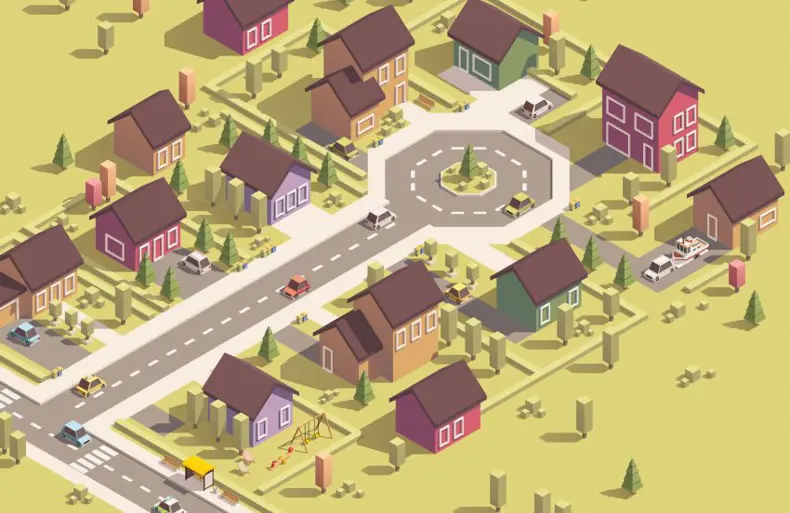
Build to Rent (BTR) in the UK has primarily been associated with new build blocks of apartments located in major city centres, benefiting from amenities such as a roof garden, 24-hour concierge, gym, communal lounge and private dining space. However, interest from investors and developers in suburban BTR housing is growing and we are beginning to see increased investment in this tenure.
What is driving the resident demand?
Affordability constraints on home ownership remain an issue for many would-be owner occupiers, with more people than ever now likely to rent throughout their lifetime.
As people grow older and their lifestyles change, so do their accommodation requirements: larger properties in less urban locations become more desirable, preferably a house with a garden in close proximity to local amenities, employment and city centres. BTR housing offers accommodation of similar quality to that of the city centre developments residents have become accustomed to as young professionals, but in a family orientated suburban location.
What is the appeal to investors?
‘Cradle to grave’ is the terminology being used for the emergence of a wider range of institutional-grade rental products. Student accommodation today is unrecognisable from the halls of yesteryear. Likewise, the standard of rental accommodation demanded by residents is rising, and it is expected that the family housing and senior living sectors should follow suit.
Investors are attracted to the low risk characteristics of housing, including a vastly more flexible breakup option compared to a block of apartments and a wide target demographic.
The first movers
The £700m joint venture between Sigma Capital Group and Gatehouse Bank, which commenced in November 2014, came ahead of the pack. Their strategy was to acquire plots of between 50 and 100 units, either as part of a wider housebuilder’s site, or smaller self-contained sites, largely in the northern regions where land and house prices are at attractive levels. A number of other investors and developers have followed in this format, with minimal on-site amenity and differentiating from buy-to-let investors by offering professional landlord ownership.
The ‘evolution’
Whilst the ‘Sigma’ model has been very successful, this approach does not provide full control over the wider scheme, and investors sometimes rely on the housebuilder or a management company for decisions, which could impact their investment.
There is now a new wave of investors entering the BTR housing space with a different approach. That is, to focus on larger scale contiguous schemes that allow control under one operational platform and bear more resemblance to a BTR block of apartments. Investors are then able to devise their own management strategy, considering landscaping, a refuse plan, amenity etc. Generally, more family orientated amenity will need to be provided. We often see flexible space that could double as a parent and baby club, arts and crafts workshops, a venue for coffee mornings, game nights, yoga classes, etc.
Services such as superfast broadband, a concierge, or security service still remain important. We are seeing a range of investor models focussing on different target markets. Renowned for their premium product Moda and Apache Capital, have committed to an 860-unit scheme in Brighton. Another example is M&G’s development with Crest Nicholson at The Green in Crawley.
Where does BTR housing work?
Regeneration areas or sites that are located within the ‘doughnut’ of a major regional centre, where there is a strong rental market with relatively low capital values. Investors in these locations are more comfortable assuming stronger yields as the scheme is likely to encompass the anticipated growth from the wider regeneration.
Affluent commuter areas, generally located in the southern regions, can also perform well. Residents will typically be commuting by car into the neighbouring towns or cities, which offer strong employment. Usually, these schemes attract a higher-end range of amenities including tennis courts, gyms and spas. These types of location will have good rental levels but, when capitalised, still offer a large discount to vacant possession value. For an investor, returns can be achieved through the income, but also by the potential future break-up option where certain parts of a site could be traded and additional value realised.
Going forward, we anticipate seeing growth in all areas of the BTR family housing space. For the smaller scale model, the focus is still on 50 to 100 units, whereas for a contiguous bespoke BTR housing scheme, 150 units plus are generally required in order to support efficiencies from an investment perspective, but also to achieve the goal of community creation.


